

Our civilisation is already dying, poisoned from within by its own virtue.
Let me tell you a story that may shock you but gives rise to this essay. My late uncle Jordan was raised in northern India. In his early eighties he expressed to me his regret at not having any children. (As it happens he may have planted a couple of unofficial seeds, but we gloss over that part of his history). He told me that when he was in his late forties, recently separated from his wife, he went to visit a childhood friend near Lucknow: a tea plantation owner who would drive around his plantation in a gold-plated jeep. A housekeeper who had overheard that Jordan was 'single' passed the word on. That evening as Jordan was enjoying a whisky with his friend there was a tentative knock on the door. The open door revealed a line of about twenty mothers, each with a young daughter in tow. Horrendous to our eyes because the age range appeared to be twelve to sixteen. A nervous spokesperson at the head of the queue explained that all these women would be honoured if Jordan would consider marrying their daughter. This was not a sexual transaction, and Jordan understood this. But those many years later he turned to me and said, "If I had said yes, I would have a huge family now. I wish I had said yes."
The unintended consequence of Jordan's ethical squeamishness was that his line would end at his death. Perhaps such ethical squeamishness is part of the reason our civilisation is going to die.
This essay is neither polemic nor cure, it calls for courage, nothing more.
Civilisation generates the poison that kills it.
Across the developed world, total fertility rates (TFR) have fallen below the replacement threshold of 2.1 children per woman and continue to fall. South Korea recorded 0.72 in 2024. China, once the most populous nation in human history, sits between 1.0 and 1.2 depending on the source and the willingness of the source to report honestly. Italy, Spain, Greece, Japan, and most of Eastern Europe hover between 1.1 and 1.4. No advanced economy has returned a sustained TFR at replacement level in the modern era. Israel, at just above 2.1, is the sole exception, and its exceptionalism is theological, not replicable by policy.
The projections from these numbers are arithmetic. China will lose half its current population by 2100 under the United Nations median scenario, returning to a headcount last seen in the late 1950s. That median scenario is optimistic: it assumes fertility recovery for which no mechanism exists. South Korea's demographic curve, if sustained, describes the functional disappearance of Korean civilisation as a demographic entity within three generations. These are the central case.
I cannot overstate the catastrophe this represents for such countries. Its a slow disaster... but it is faster than the impending rise of sea levels and we are acting upon that now.
Oswald Spengler, working backward from the ruins of classical civilisation, described the civilisational cycle in cultural terms: the late flowering of a high culture, the hardening into mere civilisation, the loss of creative force, the surrender to younger peoples with intact vitality. He thought the timescale was centuries. Looking at Rome between the Antonine peak and the formal collapse of the Western Empire in 476, he was right. Rome's demographic decline was real but slow, buffered by the institutional persistence of forms whose substance had already been replaced.
What Spengler could not see was the mechanism. He diagnosed the symptom: vigour lost, fertility abandoned, the frontier populated by the next people in line while the centre administered itself into irrelevance. He had no biology and he could not explain why civilisations evaporate.
I hold an image in my mind from moments when I am cooking. As one looks into any mixer of, say, batter one sees a constant base to surface churn. The surface layer is replaced by a layer below until the old surface layer is subsumed. So it is with civilisational churn. It is an inevitable cycle, or is it?
These poisons are produced as unintended consequences of well-meaning civilised actions.
The standard account of fertility decline points to urbanisation, female education, rising child costs, and cultural individualism. These factors are real. They explain some of what we observe. They do not explain all of it, and the fraction they leave unexplained is growing.
Each mechanism named below was the unintended consequence of something that was right to do, or at minimum, something done with genuine intent toward human welfare. Bismarck did not design the pension system to destroy the family. Housing markets were not inflated to prevent reproduction. The push for gender equality was not intended to suppress masculine biology. Industrial chemistry was not deployed as an endocrine weapon. Civilisational stability was not built to send a signal to our neuroendocrine systems to stop breeding. But each of these things happened anyway, compounding in systems nobody was watching, producing an outcome nobody designed and nobody voted for.
The last poison, an epigenetic argument is the most unstudied and thus the most elaborated. It deserves an essay of its own but from a fearless anthropologist.
Poison One: The structural destruction of the intergenerational contract.
State pension systems, introduced across the developed world through the twentieth century, severed the oldest and most powerful incentive for fertility: the knowledge that children are the mechanism of old-age security. Pre-modern families were large because large families were survival. The state pension answered that need collectively, which was humane, and simultaneously told the individual that having children was now optional, which was catastrophic. Every function the family once performed as an economic unit, the welfare state has progressively assumed. What remains is the emotional logic of family formation, real but insufficient, competing against every other claim that modernity makes on time, money, and identity.
The Brazil natural experiment is instructive. When the pension system expanded to rural workers and their pension wealth tripled, completed fertility fell by 1.3 children per woman within twenty years. This is a clean treatment effect. The same mechanism, operating at civilisational scale across a century of welfare state expansion, has produced the demographic outcome the economic model predicts. The timing fits. The magnitude fits. Nobody in mainstream political economy will say it plainly because the implication is that the welfare state is consuming its own demographic foundation.
There is a further irony that the standard account declines to pursue. The pension system suppresses fertility and then fails because of it. Pay-as-you-go pensions are arithmetically dependent on a contributor base large enough to fund a recipient base. Shrink the contributor cohort, which is what suppressed fertility produces, and the system becomes insolvent. The solution to old-age insecurity created the demographic condition that makes old-age insecurity unavoidable. The populations that traded children for state pensions are now discovering that the state pension cannot be afforded in a world without enough children to fund it. They will have neither. The mechanism that caused the problem is being destroyed by the problem it caused, but too slowly and too late to reverse the fertility collapse it set in motion. This is the logical terminus of the original design, playing out across a timescale long enough that no politician who voted for it was still in office to be held responsible.
Poison Two: Inflate the economy to distribute wealth and the resulting asset inflation suppresses the biological fertility window.
The second mechanism is distinct from individualism and deserves its own accounting: the economic pressure on women created by asset inflation. Housing across the developed world has inflated beyond the reach of a single income in most urban centres where economic opportunity concentrates. This is the result of treating residential property as an investment vehicle rather than a social good, a choice made by homeowners, pension funds, and governments simultaneously, each rational in their own interest, none intending the fertility consequence.
(Author's note: I am not going to dwell on the underlying theories that have given rise to this inflation. The result must, in this essay, speak for itself.)
The result: two incomes are now structurally required to service a mortgage. This forces the compression of the female fertility window into its least biologically productive years. A woman who begins her career at twenty-two, spends a decade establishing economic stability, and begins attempting conception at thirty-two is working against a biology that peaked fifteen years earlier. The economic structure did not intend to do this. It did it anyway.
Poison Three: If we lose pride in community, we lose a wider sense of the importance of having children.
Communities with above-replacement fertility share almost no ideological common ground. Haredi Jews in Jerusalem, conservative Mormons in Utah, Pashtun villages in the Afghan highlands, orthodox enclaves in Brooklyn, rural Anatolian families, tribal communities across sub-Saharan Africa. They differ in theology, in economy, in education, in every variable the sociologist reaches for. What they share is pride. Pride in the nation if the nation is the identified unit. Pride in the village if the community is small and bounded. Pride in the sect if the collective is defined by covenant. In each case the individual understands that the collective has a future worth reproducing, and that reproducing it is an obligation of honour rather than a lifestyle choice. Children are the mechanism by which something worth preserving is preserved.
The progressive cultural project of the past half-century has, as a systematic consequence of its values rather than its intentions, made collective pride illegitimate. The attack falls on pride in community, on the grounds that collective pride has historically curdled into exclusion, nationalism, and the persecution of outsiders. That suspicion has historical warrant. The pathological forms of collective pride are dangerous. But the cure dissolved something load-bearing. What replaced collective pride is either the thin universalism of liberal cosmopolitanism, which generates no fertility because no one reproduces on behalf of humanity in the abstract, or identitarian grievance politics, which is community organised around wound rather than continuity and produces the same demographic result. Neither makes people want to raise three children. Neither was designed to. The fertility consequence was collateral, unintended, and is now irreversible by the same cultural instruments that produced it, because you cannot mandate pride and you cannot subsidise meaning back into existence.
Poison Four: The 'civilised' fertility window.
Female fertility peaks in the late teens and early twenties. It declines measurably after thirty, sharply after thirty-five. Egg quality degrades, miscarriage risk rises, conception rates fall. This is endocrinological, not cultural. Modern societies have, through the entirely defensible mechanisms of compulsory education, credentialism, career infrastructure, and cultural messaging about the relationship between ambition and early motherhood, systematically pushed first reproduction to the late twenties and thirties. By the time a woman is economically stable enough to have children, she has spent a decade in the least reproductively efficient window of her biological life. She has not made a wrong choice. She has made the choice the entire structure of civilised opportunity-provision demanded of her. The fertility cost is structural, not personal, and it compounds at population scale without anyone intending it.
Poison Five: Sperm count decline may be an epigenetic response to civilisation itself.
Sperm counts in Western males have fallen by approximately fifty percent since the early 1970s by the most comprehensive meta-analyses available. Testosterone levels have been declining across cohorts independent of age. These are biological signals. The endocrine disruption hypothesis attributes them to plastics, pesticides, sedentary behaviour, and metabolic change, and those factors are real. But they do not explain the cross-cultural variance in the data: populations with equivalent or higher chemical exposure show markedly different reproductive trajectories. The biological picture has residuals the environmental model does not account for.
The established candidates are well-documented. Phthalates and bisphenol A mimic oestrogen and suppress testosterone synthesis. Organophosphate pesticides disrupt the hypothalamic-pituitary-gonadal axis. PFAS compounds interfere with thyroid and sex hormone signalling. Urban particulate matter reduces sperm motility through oxidative stress pathways independent of hormonal disruption. The science on individual mechanism is solid, the research programmes are active and funded, and the field, led by groups including Shanna Swan at Mount Sinai and Niels Skakkebaek's team in Copenhagen, has been producing consistent findings for two decades. The individual exposure model produces consistent findings on individual reproductive impairment. The population-level fertility divergence is a different inquiry, and the field has not turned to face it.
The sharpest challenge to endocrine disruption as the primary explanation is geographical. Sub-Saharan Africa carries among the highest chemical burdens on earth: biomass burning on an industrial scale producing dioxins and polycyclic aromatic hydrocarbons, widespread lead contamination, organophosphate pesticide exposure, pervasive household burning of chemical waste. The pooled total fertility rate across thirty-three sub-Saharan African countries runs at five children per woman. Nigeria, among the most chemically burdened large nations on earth, recorded 4.4 in 2024. The EDC hypothesis documents individual impairment of reproductive function. The population-level fertility data in heavily polluted African nations runs in the opposite direction. Something else is doing that work, and the field has not identified what.
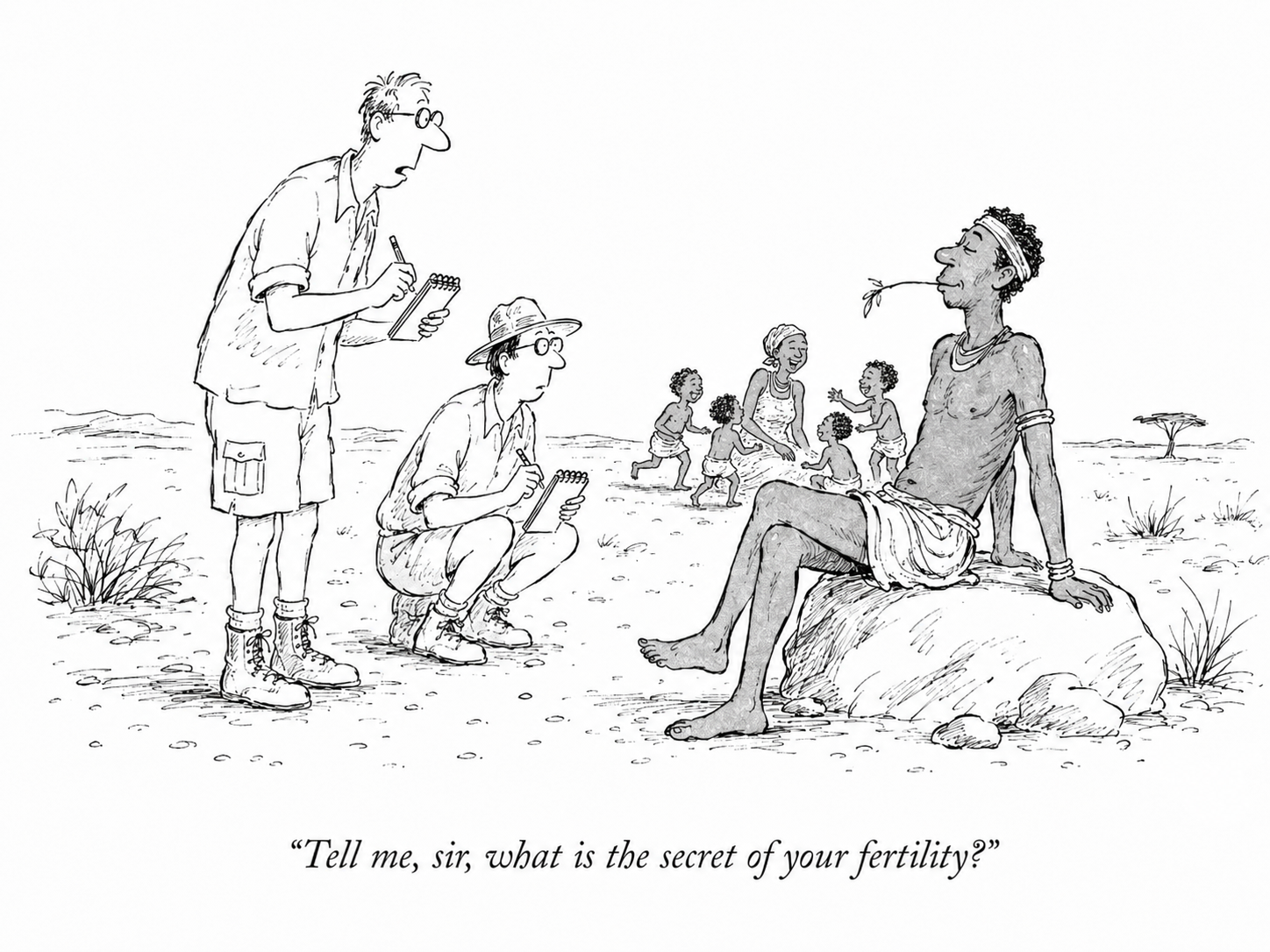
Behind those residuals sits a hypothesis that is biologically literate, mechanistically plausible, and institutionally untouchable. Across dozens of species, organisms adjust reproductive strategy in direct response to population signals, through hormonal and epigenetic pathways that operate below conscious behaviour. Evolution would strongly favour any organism capable of detecting demographic stress and modulating fertility accordingly. Whether humans possess such a mechanism, and whether that mechanism is currently active, has never been studied. It has never been studied because the question sits at the intersection of population genetics, endocrinology, and cultural anthropology, in territory that the academic incentive structure treats as radioactive. The researchers most capable of designing the study are the researchers with the most to lose from the answer.
There is a further dimension to this hypothesis that carries no direct evidence in humans but is biologically coherent. A dying plant flowers. Under existential stress, organisms mobilise their last reproductive resources: the biological signal reads propagate now or die without issue. Modern civilised populations live in the safest, most resource-rich environment in human history. No existential threat, no scarcity signal, no urgent pressure to reproduce before the window closes. If something in our neuroendocrine architecture reads environmental stability as reproduction can wait, the adaptive response to civilisational success is fertility suppression. The organism perceives its survival situation and responds accordingly. We have stopped flowering because we read safe forever. The problem is that safe forever is precisely what we were trying to build.
The closest biological relatives offer evidence that is illustrative without being probative, and the distinction matters. Subordinate female common marmosets (Callithrix jacchus) living within established social groups are rendered completely anovulatory, reproductively zero, by chemical signals from the dominant female. The mechanism is well-characterised: pheromonal signals suppress the LH surge required for ovulation through hypothalamic GnRH pathways, operating below conscious behaviour.1 Remove the subordinate female from the hierarchy and ovulation resumes within ten days. This is population-regulated, socially-mediated reproductive suppression in a higher primate. The collective manages its own fertility through neurochemical signals the individuals have no awareness of.
The genomic layer is provided by work on rhesus macaques. Using experimentally controlled social hierarchies in which individual rank could be assigned and altered, researchers showed that dominance rank produces a widespread and plastic imprint on gene regulation: blood cell gene expression data alone predicts social status with eighty percent accuracy. The same study identified global associations between dominance rank and DNA methylation profiles, consistent with epigenetic flexibility in direct response to social cues.2 Social position is readable in the genome. It leaves marks.
The longest field record comes from wild baboons at Amboseli in Kenya, studied continuously since 1971. Analysis of DNA methylation data from 248 individual animals showed that male dominance rank is the single strongest predictor of epigenetic age, stronger than chronological age itself. High-ranking males run epigenetically older than their years; when rank changes, epigenetic age tracks the change within the same individual over time.3 Social trajectory writes itself into the biological clock.
None of this proves the human population-sensing hypothesis. Marmoset reproductive suppression operates within a small social group, not a demographic aggregate. The macaque epigenetics concerns immune gene regulation rather than reproductive function directly. The baboon data addresses individual rank within a troop, not species-level population dynamics. But taken together, these findings establish that in higher primates, social structure calibrates reproductive biology through epigenetic pathways, operating automatically, leaving measurable molecular traces, and reversing when the social signal changes. The machinery exists in our order. Whether an analogous mechanism operates in humans at population scale is the question that has not been asked.
A specific candidate: demascularisation as epigenetic suppressor
The same progressive project that dissolved collective pride also systematically devalued and pathologised traditionally masculine traits: physical dominance, competitive status-seeking, risk-taking, territorial behaviour. The intention was sound: those traits, when unconstrained, had genuinely been used to dominate and exclude. But the cure may carry a biological cost that nobody measured. Testosterone is the most visible signal but the mechanism runs deeper than testosterone alone. The entire motivational and endocrine architecture for reproductive behaviour (courtship drive, competitive resource-acquisition, pair-bonding, the dopamine reward pathways for status and territory) is partly scaffolded by social permission to express masculine identity. Suppress that permission systematically and the whole system may respond. Luteinising hormone, growth hormone, cortisol dynamics: all are candidates for epigenetic modulation in a social environment that consistently signals masculine drives are pathological. The primate evidence above suggests social signals calibrate reproductive biology automatically, below conscious behaviour. Demascularisation may be one specifically human mechanism doing exactly that.
The compounding effect of the poisons.
Some compound. Some reverse. The distinction matters for understanding why the system is harder to escape than it looks.
The epigenetic mechanism, if real, compounds in the only direction that counts: downward, across generations. Each cohort inherits a more suppressed reproductive baseline than the one before. Unlike economic variables, this does not self-correct when conditions improve. The encoding deepens. By the time the mechanism is characterised and the signal source identified, several generations of suppression have already accumulated.
The loss of collective pride and the demascularisation of society reinforce each other. Collective identity provides the social structure within which masculine reproductive drives make sense: the community worth defending, the lineage worth extending. Strip collective pride and you remove the frame that gives masculine expression biological purpose. Suppress masculine expression and you remove one of the emotional engines that generates pride in collective continuity. Neither recovers without the other.
Demographic momentum compounds mathematically. A smaller reproductive cohort produces fewer children in absolute numbers even at an identical TFR. The floor drops with each generation regardless of individual choices.
Housing and asset prices work differently. Declining population eventually relieves asset inflation: Japan's shrinking cities, China's vacant tier-three developments are already evidence of it. This is reversal, not compounding. But the reversal arrives too late to help fertility and brings its own form of catastrophe: household wealth stored in property evaporates alongside the population that was supposed to sustain it, pension funds that financed housing inflation collapse with their asset base, and the economic argument for having children, which might in theory reassert itself once housing is affordable again, arrives into a society whose biological and cultural capacity for reproduction has already been suppressed across several generations.
Each was moderate, well-intentioned, and independently insufficient to collapse a civilisation. The ones that compound do so quietly, beneath the threshold of political visibility, across timescales that exceed the career of any single policymaker.
Implication
A nihilist might say, this doesn't matter. "Our population deserves to die" or "men can be replaced" or "we will have more immigrants" or even "we will just have artificial wombs or clones". At best you should never put someone who believes in a society's demise in charge of saving that society. At worst, these are fatalist luxury beliefs, and I reject them outright.
Demographic momentum means that today's fertility decisions manifest in population structure thirty to sixty years hence. The cohorts being born now, at TFRs between 0.7 and 1.2, will be the reproductive-age population of the 2050s and 2060s. The compression of the working-age cohort relative to the elderly is locked in for decades regardless of any policy change, because the bodies are already born. Pension systems designed for demographic profiles that no longer exist are mathematically insolvent, but they still harm.
Epigenetic effects compound across generations in ways that single-generation cross-sectional studies cannot detect. If the biological suppression hypothesis has validity, the signal in the current generation reflects accumulation across the previous two or three. By the time the mechanism is characterised, the cohort damage is three generations deep.
The intervention timescales are brutal. Even if the causal weights were established tomorrow, and the optimal intervention designed by next year, and the political will assembled to implement it, the demographic effects of any change in fertility behaviour would not register in population structure for twenty to thirty years. History offers no example of a society that recovered from a TFR below 1.0 to reach replacement. The trajectories that exist all run in one direction.
Differential fertility between communities is current. The populations maintaining above-replacement fertility are inside the borders of the populations that are not. The replacement is demographic, not political, and it proceeds by arithmetic.
Spengler described a cycle he could not explain. The cycle appears to be self-correcting at a level that renders human agency irrelevant if the corrective is left too late. Like the cycle of boiling water, the vigorous replaces the evaporated, itself eventually civilises, eventually evaporates. Whether this is tragedy or mechanism depends on whether any particular civilisation deserves to persist.
Need
What is required is a single, major, privately funded, interdisciplinary study of scope and independence to pursue all five causal vectors simultaneously and return a credible weighting.
The study must be interdisciplinary in a way that existing siloed research is not. Demographers model cultural and economic variables. Endocrinologists study individual chemical exposure. Epigeneticists examine intergenerational biological transmission. Political economists analyse welfare state incentives. Cultural anthropologists examine community identity and fertility norms. None of these conversations is integrated with the others. The causal picture requires all five simultaneously, because the hypothesis tree compounds rather than adds. The factors interact. Pension removal of child security value operates differently in a culture with intact collective pride than in one without it. The biological suppression signal, if it exists, sits on top of and is confounded by the cultural and environmental signals. Separating these requires a study design that no single discipline will construct because no single discipline can see the whole frame.
The study must be longitudinal. Cross-sectional snapshots capture correlation, not mechanism. Tracing the epigenetic, endocrine, cultural, and economic variables through cohorts across time, in populations with different trajectories, is the only methodological approach that can establish causation at the level of precision required for intervention design.
The study must be politically independent from the point of design. This means private funding from a donor whose concern is the question rather than the answer. It means institutional structures that insulate the research team from peer review at the hypothesis stage, where the social pressure to pre-sanitise the inquiry is greatest. It means publishing whatever the data shows, including the conclusions that are most unwelcome to the most powerful interests, because the alternative is another decade of knowing something is catastrophically wrong and being unable to say what it is.
The study must culminate in a public argument addressed to governments, foundations, and the communities most directly affected, with intervention recommendations scaled to the causal weights established by the research. If the pension mechanism dominates, the intervention is fiscal and structural. If collective pride is the primary casualty, the intervention is cultural and must operate at the level of meaning rather than subsidy. If the biological mechanism is real and significant, the intervention is medical and requires acknowledging that something is being done to human reproductive biology that nobody planned and nobody is yet monitoring. The intervention architecture cannot be designed until the weighting is known. The weighting cannot be known until someone asks properly.
Every decade of delay is a decade of compounding loss in a system where the losses are locked forward thirty years. The intervention window is not permanently open. In the late 2030s, half the women in the countries whose populations have peaked will be past natural reproductive age. The cohorts available to reverse the trend shrink with each year the study does not exist.
The scientific cowardice that keeps these questions unasked has a cost.
Conclusion
The policy record on fertility intervention is unambiguous and unacknowledged. No advanced economy with a TFR below replacement has returned to replacement through policy. Hungary has spent five percent of GDP for fifteen years and sits at 1.5, falling again. South Korea has spent an estimated two hundred billion dollars on pronatalist programmes since 2006 and recorded 0.72 in 2024. The interventions reduce friction: subsidised childcare, parental leave, housing support all help at the margin. They buy perhaps 0.2 to 0.4 above the floor. The floor holds. The floor is structural and the structure is what modernity built.
The symptomatic treatments share a fatal characteristic: they address the decision to have children without addressing the reason to have them. A cash transfer to a couple weighing a second child against a mortgage and a career is a legible financial intervention. It cannot tell them why the future matters enough to invest in it biologically. Fertility drugs cannot be prescribed to a culture. Worse: medical solutions to fertility decline (IVF, testosterone supplementation, hormonal intervention) add more chemical signals to a system already saturated with chemical disruption. If the endocrine suppression is partly caused by environmental chemical load, pharmaceutical hormones accelerate the problem they are trying to solve. Treating the symptom when the cause is structural produces dependency without resolution. The biology gets more confused, not less.
The study proposed in this essay will produce findings some of which point toward solutions that cannot be taken. Restoring early marriage (and there is a direct biological argument for it, since female fertility peaks in the late teens and declines sharply after thirty-five) is morally unconscionable. Coercing women out of economic participation is morally unconscionable. Deliberately reintroducing scarcity and threat to reactivate reproductive urgency is absurd. Reversing the equality project to restore collective masculine pride through exclusion is wrong. These solutions exist in the data. They will appear when the causal weights are established. The study must name them and then set them aside as foreclosed, not from squeamishness, but because the costs exceed the demographic problem they would solve. What remains after the unconscionable solutions are removed is a much smaller set of interventions: restructuring pensions to reconnect child-rearing with economic security, addressing asset inflation so that a single income can sustain a family, permitting collective pride without treating it as automatic evidence of exclusion, investigating the epigenetic and endocrine mechanisms before another generation encodes the suppression more deeply.
The honest position is that some of what we would need to do, we cannot do. And by not doing it, we contribute to our own decline. That is the bind.
I do not want to be right about this. A world in which the price of civilisational survival is the abandonment of the liberal settlement is not a world worth saving in the form proposed. But the data does not ask permission. The TFRs are what they are. The pension arithmetic is what it is. The primate biology is what it is.
We are in a race between the slow cultural work of rebuilding meaning within open societies (which may be possible, is not guaranteed, and has no historical precedent) and the demographic clock, which is not slow and does not negotiate. The study proposed in this essay is the minimum condition for running that race with any intelligence. Without knowing the causal weights, interventions are guesswork. Without the political will to look at the uncomfortable hypotheses, the weights cannot be established. And without the weights, the cultural work, even if attempted, has no map.
I do not want to be right. But I don't think I am.
Notes
1 Abbott DH, Hodges JK, George LM. Social status controls LH secretion and ovulation in female marmoset monkeys (Callithrix jacchus). Journal of Endocrinology. 1988;117(3):329–39. doi:10.1677/joe.0.1170329. PMID: 3134506. See also: Barrett J, Abbott DH, George LM. Extension of reproductive suppression by pheromonal cues in subordinate female marmoset monkeys, Callithrix jacchus. Journal of Reproduction and Fertility. 1990;90(2):411–18. doi:10.1530/jrf.0.0900411. PMID: 2250240. The sensory pathway was further dissected in: Barrett J, Abbott DH, George LM. Sensory cues and the suppression of reproduction in subordinate female marmoset monkeys, Callithrix jacchus. Journal of Reproduction and Fertility. 1993;97(1):301–10. doi:10.1530/jrf.0.0970301. PMID: 8464022.
2 Tung J, Barreiro LB, Johnson ZP, Hansen KD, Michopoulos V, Toufexis D, Michopoulos V, Wilson ME, Gilad Y. Social environment is associated with gene regulatory variation in the rhesus macaque immune system. Proceedings of the National Academy of Sciences. 2012;109(17):6490–95. doi:10.1073/pnas.1202734109. PMID: 22493251. For the subsequent chromatin accessibility work, see: Snyder-Mackler N, Somel M, Tung J. Social status alters chromatin accessibility and the gene regulatory response to glucocorticoid stimulation in rhesus macaques. Proceedings of the National Academy of Sciences. 2019;116(4):1219–28. doi:10.1073/pnas.1811758115.
3 Anderson JA, Johnston RA, Lea AJ, Campos FA, Voyles TN, Akinyi MY, Alberts SC, Archie EA, Tung J. High social status males experience accelerated epigenetic aging in wild baboons. eLife. 2021;10:e66128. doi:10.7554/eLife.66128. The Amboseli Baboon Research Project has been running continuously since 1971 and constitutes one of the longest individual-based studies of a wild mammal population in existence.

Discussion