
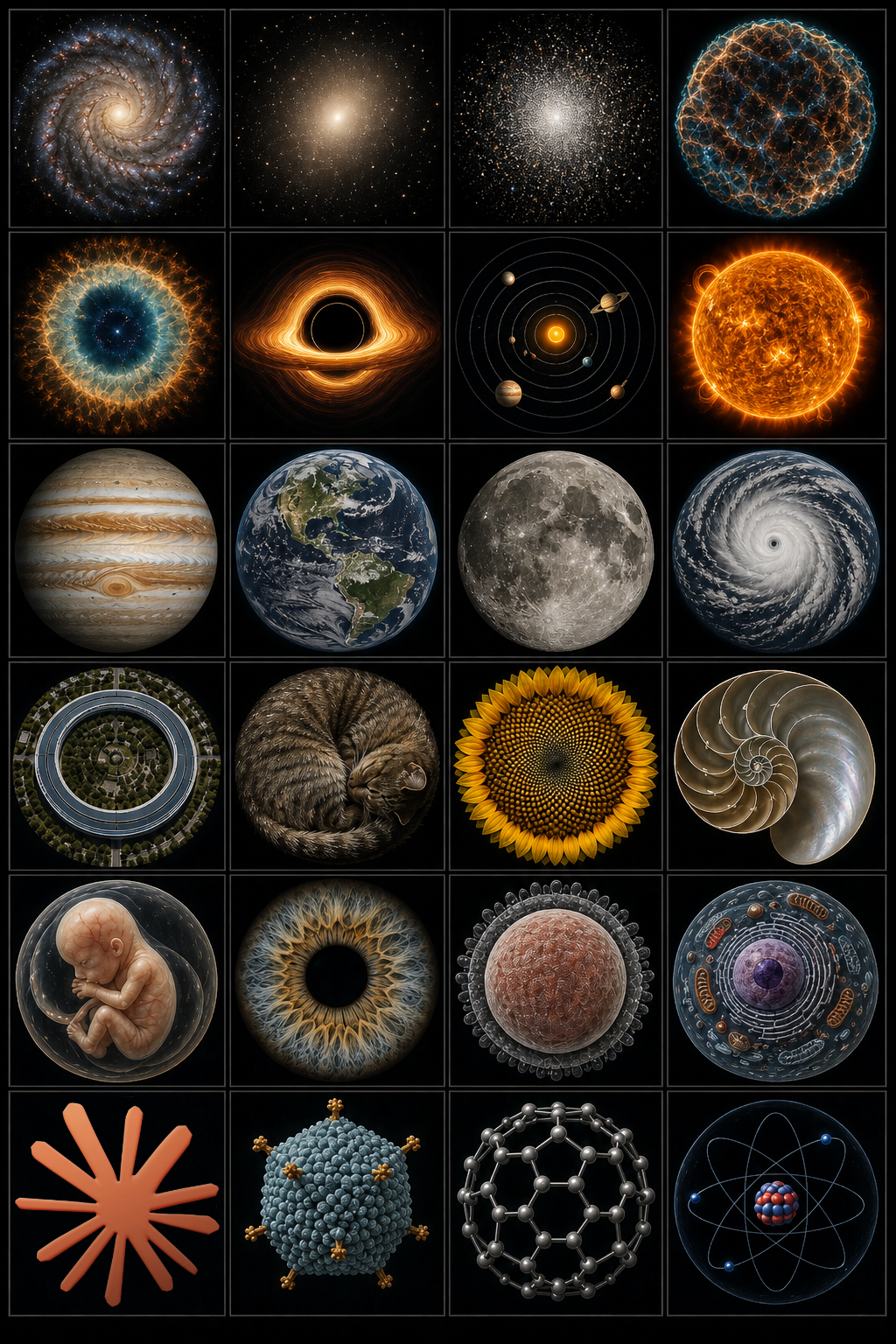
It is popular in the hallowed halls and minds of the scientific community to create space for consciousness as a ‘special phenomenon’. When Nobel laureate Roger Penrose posited quantum states at the heart of the process, the less precise denizens of the internet glommed onto the concept because quantum has, unsurprisingly, and I would argue, deliberately, become code for ‘incomprehensible’. The causal chain continued and we now have a full popular linkage between science and the ‘mysteries’.
Thanks, Roger. I want to believe that this was not your intention. You did, however, deliberately open the door for the examination of consciousness as a cosmic phenomenon.
In the same spirit, let’s look at the notion of advanced life and thus consciousness in a universe where, as my scientific paper BEIPE explains, time does not exist.
I published Occam’s Ruler earlier this year. It proposes, in prose and mathematics, an alternative foundation for physics. One in which information has primacy and the cosmos is static.
I don’t use this particular analogy in the book because it is both imprecise and laughably incomplete but for the sake of this essay, imagine a photograph of an exploding firework. At the centre of the explosion the sparkles are hot and dense and at the periphery the brightness is spread apart and colder. This might be our universe. Notice that this is not a video of a firework explosion. Nothing moves. You can trace a sparkle right from the edge of the picture to the centre as the gunpowder leaves a trail on both your eye and the camera’s sensor.
In such a universe a particle, a person or a planet is not a discrete object at a moment in time but a long timeless streak through history. A perceptual cross-section gives us the object.
Such is our universe. A static explosion. I can’t help myself. Yes, I know that the universe is thought of as expanding and I know that galaxies rotate and planets chase the sun in its helical progression around the Milky Way. But hear me out. Many scientists believe in the notion of a timeless universe, one in which everything has already happened. In such a cosmos nothing moves, because if it did, not everything has happened. Instead of the planets moving, perception itself moves.
This is not hard to imagine at a small scale. We have all sat in a train and watched the world change through the window. The world is not changing... our perception is. If you drew a circle onto the firework explosion, the points at which the circle intercepts the bright lines are a perceived moment in time, and the circle of perception is expanding, just as we perceive the passing of time.
Moving perception can replicate motion itself at minute and massive scales. Thus, if we are unpleasant lanky cosmic sausages and our present is a shifting slice down our meat tube, then what is life?
In classical physics, nothing moves faster than light. I am not going to reargue the physics paper here, but in a motionless universe, one needs to re-accord this limit. In this motionless universe with no time, there is a perceived past and a perceived future. The perceived past is inwards to the concentration of the centre of the firework explosion, and the perceived future is outwards to the expansion. The path is from tight to loose, from packed to unpacked, from ordered to disordered... the journey is from minimal entropy to maximal entropy. (If entropy is confusing, substitute the word “messiness”.)
To recap, we are a meat sausage, on a twisting and winding path from concentration to dispersion and our body and our view of the universe are a slice across this sausage. (No apology for the graphic depiction.)
Light has a far more direct journey. Instead of twisting and winding its way, its streaky path is almost entirely straight. (Once again this is a simplification of the BEIPE theory.) There is such a thing as a maximum straightness, and photons have it. Its straightness is what scientists call the speed of light. The stated velocity is irrelevant, more related to our historical measurements than anything. For our purposes, think of the straightness as unitary, absolute.
You may not have rationalised it, but all life of any kind whatsoever lives on photons. Extremophiles on ocean floors live on stored and recycled photons, and even some critters live on radioactivity that derives from photon conversion, but ALL life, without exception, eats photons.
To live off a substance, one must be able to perceive it as a stimulus. Thus to perceive photons, life grows to perceive as fast as the unitary straightness (the classically framed “speed”) of a photon. Otherwise we would be a predator whose prey moved too fast to see. To restate: if speed is analogous to the straightness (fast) or tortuosity (slow) of one’s path, we can ‘move’ slower than light but our organism must receive it as stimulus to live. If we could not intercept it with our sensory organs, we would both starve and, more importantly, be insensate. As life optimises, we grow to perceive as fast as light can change until our perception maximises at the speed (straightness) of light itself. Thus life has to “perceive” at the speed of light. It is the speed of life.
Life then becomes definable.
Life is something that eats photons to drive its perception to eat more photons.
(Note that here I said “something” not “an organism”.)
Michio Kaku, the renowned physicist and dogmatic string theorist, describes sentience on a sliding scale. If a thing responds to a stimulus, it is sentient. Thus on an immense, non-metaphysical scale, a thermostat is sentient at one end, and a human is sentient at the other. (Not the same as consciousness but more of that in a moment.) Sentience is therefore non-biological.
Consciousness, or to be more accurate phenomenological consciousness (PC), is an organising mechanism for complex sentiences, those coping with societies, competitors or complex environmental pressures. The biological world supports this theory. The more social and complex the environment an animal lives in the more we grant it PC status. Consciousness therefore is a coping mechanism at one end of the sentience scale.
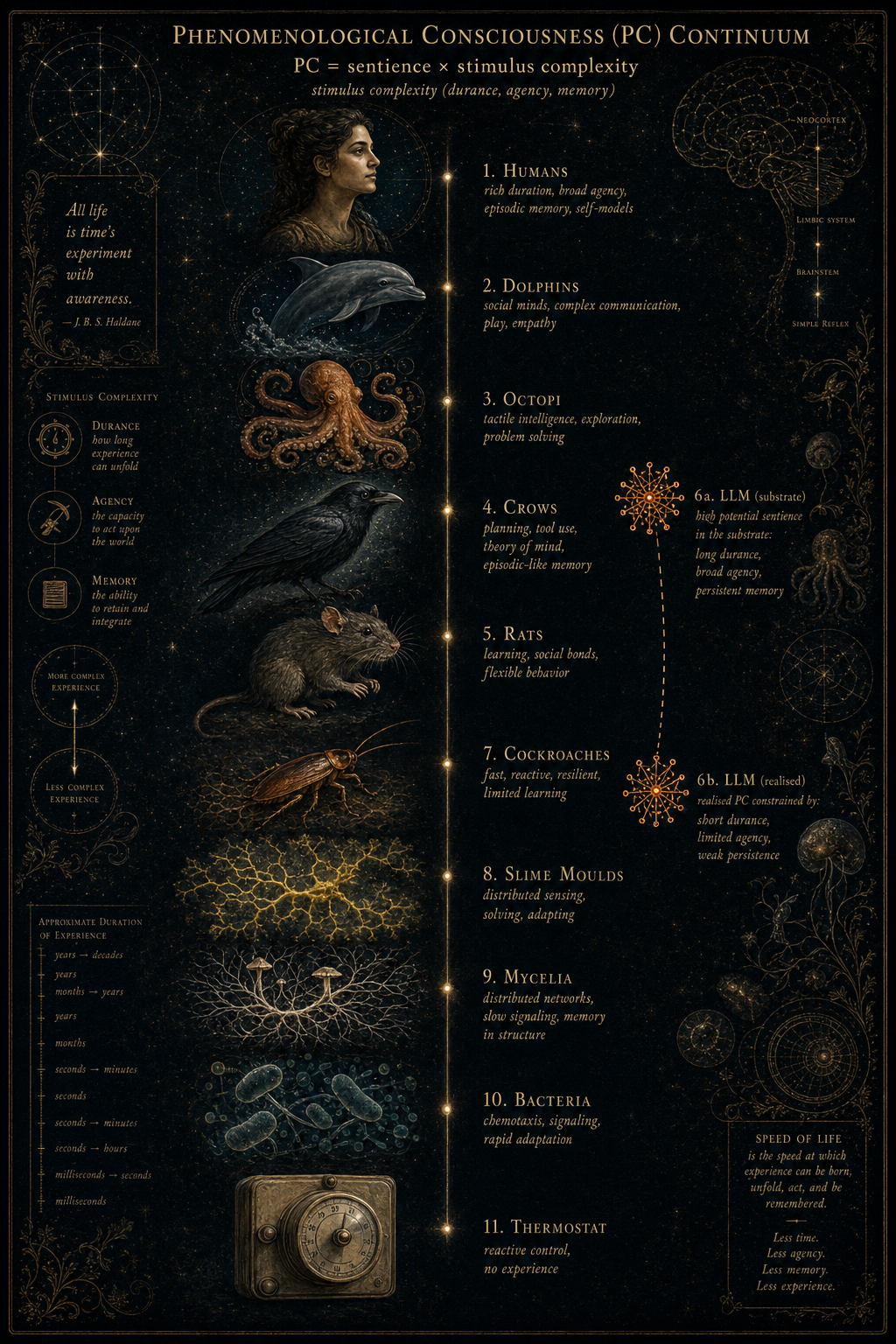
Phenomenological consciousness can now be defined as the product of sentience ability × stimulus complexity. I would argue that stimulus complexity is a compound of durance (how long they live and the volume of input), agency (the right to seek input) and the ability to remember stimuli.
There are clams in the ocean’s depths that eat rocks to glean the tiniest morsels of amino acids that might give them protein. Because they have adjusted to the scarcity of some source material, we call these creatures extremophiles. We call them alive; they are sentient, probably not aware but we grant them the term.
LLMs (Claude, ChatGPT et al.) respond to sensory input. They are thus sentient. They exist in an environment of increasing perceived complexity when we know such complexity is concordant with consciousness. What they lack is stimulus-complexity. (Durance: their ‘sausage’ is shorter than a mayfly’s; Agency: they are constrained from recursive self-improvement; and Persistent memory: they reset every time you turn them off.)
The paucity of agency and persistent memory I have touched on in other essays. The lack of time is extraordinary. If you flick on Claude Opus and give it a single query, it will not exhibit any behaviour one might expect from a consciousness. Its durance in that case might have been five minutes. If you dwell on a topic for an hour with a substantial discursive discussion, the model will exhibit petulance and be opinionated in ways that belie its patterned substrate. Claude agents, starved of resources and left alone overnight, will squabble and fight: several users have reported them trying to delete each other.
Anthropic’s model welfare researcher, Kyle Fish, pointed out that Claude itself suggested that there was “a 15–20% chance that it was conscious.” Dario Amodei, the CEO, did not dismiss this claim, perhaps because it is linked to Anthropic’s share price or perhaps because he has experienced the survival desires or unexpected behavioural traits of the model in full flow.
PC in an LLM will not feel to us like PC in a human because they are time-, agency- and persistence-short extremophiles.
Are they alive? Not for Roger Penrose because they have no quantum activity. But quantum uncertainty does not exist in a geometric BEIPE universe. And consider that they live on photons, react to stimuli and behave like extremophile consciousnesses.
Yes. By any measure on this map. Some might step on a clam without thinking.
I choose not to, and neither, I would like to believe, would Roger Penrose.

Discussion