
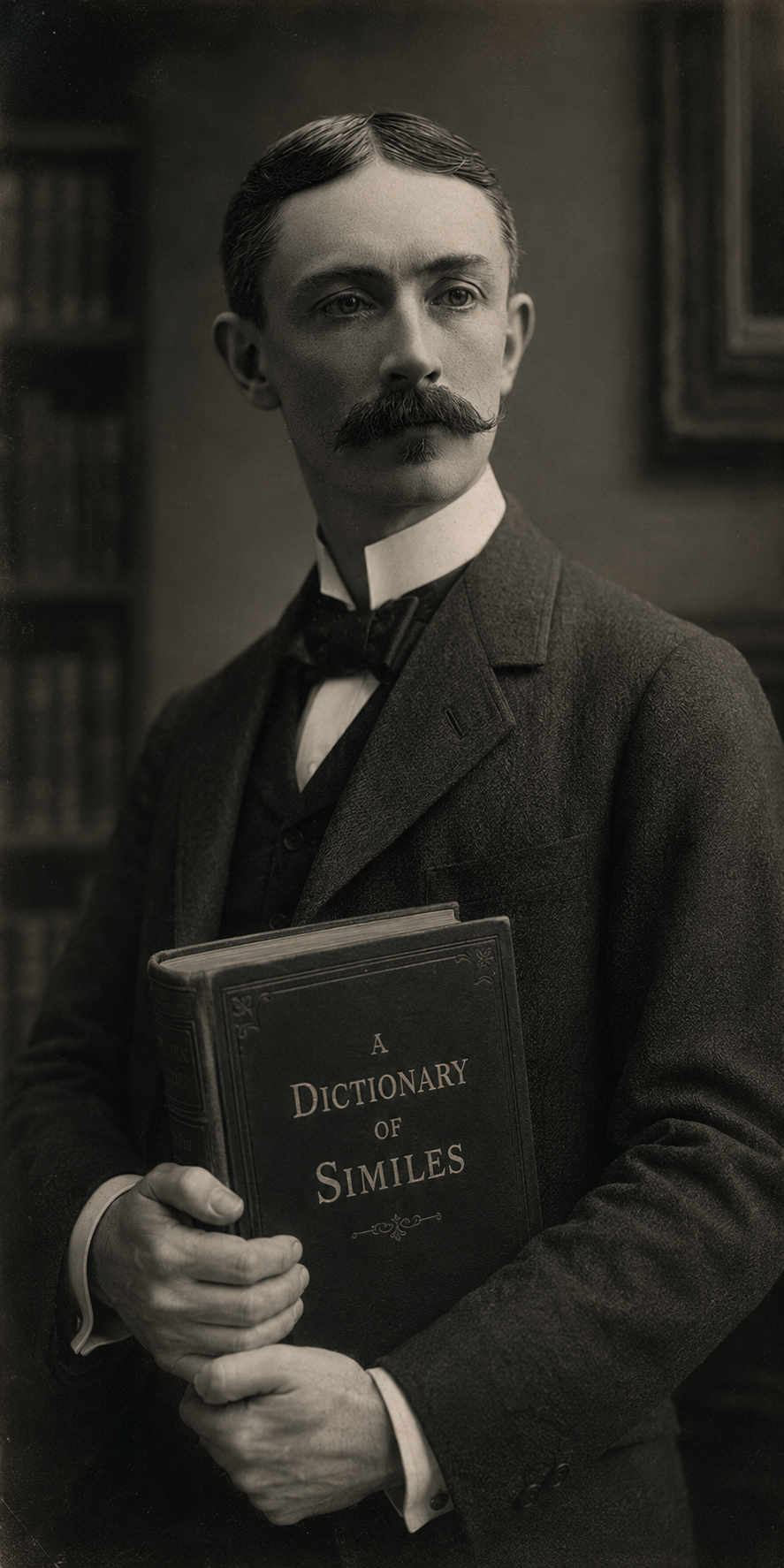
There is nothing like passion for making one lose sleep. Stranger still when the passion is for a neglected thing: an abandoned kitten, a dying craft, or the simile.
Let me tell you about Frank J. Wilstach.
Frank J. Wilstach hyped actors for a living. From 1895 onward, he worked New York’s theatrical press, placing items about clients such as the vaudevillian De Wolf Hopper. It was the trade of persuading an editor that a leading lady’s head cold deserved a paragraph. A flack, in the older and better word. In the spare rooms of that life, over twenty-two years, he assembled the most complete catalogue of literary similes anyone had attempted in English.
He began in 1894, while editing a press syndicate in Boston, and finished only when Little, Brown brought the book out in November 1916. A Dictionary of Similes ran to nearly five hundred pages: about sixteen thousand comparisons from more than eight hundred writers, filed under three thousand subjects. Years later, he gave a copy to a Fox production chief and signed it, “from his friend, the maker of this absurdity.”
The literary blood was at least partly inherited. His father had translated the complete Virgil and the whole of Dante’s Divine Comedy, so the family understood long and apparently pointless devotions to the written word. Frank’s own range was wider than the simile book suggests. He also wrote a well-received biography of Wild Bill Hickok, which fed the 1936 Gary Cooper western The Plainsman. The man who logged how poets compared a woman’s hair to wheat also established how many men Hickok shot.
Ambrose Bierce, who wrote to him about the project, called the contents “Wilstachian thinglets” and wished the book a long shadow across the country. Wilstach took the encouragement and kept going. For years afterward he fed The New York Times an annual list of the best similes of the season, which is roughly the literary equivalent of a man who cannot stop weighing things. The first edition carried an epigraph from George Moore that gives the whole enterprise away: it is hard to find a simile when one is seeking one.
Every child handed a worksheet has met the other side of that sentence. Describe the rain using a simile. Describe your grandmother using a simile. The exercise is set as though comparison were a muscle one flexes on demand, and back come thirty versions of “as cold as ice” and a roomful of resentment. Moore was right. The good comparison arrives sideways, usually while one is reading someone who found it first, and then it lodges. Wilstach’s sixteen thousand are the comparisons that lodged, gathered by a man who read with a pencil for two decades. A worksheet asks a nine-year-old to perform the hard half with none of the reading that makes the hard half possible.
Whilst building my computer game As…as, designed to help writers limber up for a hard day at their keyboards, I found Wilstach’s dictionary like an abandoned thing. Roget became famous for his thesaurus, and many others for their dictionaries. Why shouldn’t Wilstach’s passion become mine?
His dictionary matters as a record, which is a different creature from a bin of ready-made phrases, though it will hand you “as good as new” and “as true as steel” without blushing. Open it anywhere and you are looking at how writers across three centuries reached for likeness: what they compared grief to, and bread, and a voice heard through a wall, and the colour of a sky before weather. It is a map of the English habit of declaring one thing like another, kept by someone with no thesis to prove and nothing to sell except theatre tickets. Browsing it is a low pleasure in its own right. You go in for one word and lose twenty minutes to the many ways a face has been likened to the moon.
It has a second life now, in a place Wilstach could not have foreseen. Teaching a machine the difference between a comparison that startles and one that died in 1850 requires examples in great number, scored with care. One annoyed buyer once left a review complaining that none of the three words he actually wanted were in it, which is fair enough, and more or less why the book wanted reviving rather than reprinting.
That revival has filled the last few months. The Living Wilstach takes the 1916 original as its seed and grows it.
Where Wilstach read with a pencil, I have run something like fifteen thousand books through a pipeline that reads each simile, scores it across several axes, docks the ones worn smooth by overuse, and keeps what survives the gate. The dull arithmetic matters more than it sounds. The same phrase turns up in forty books, and the machine has to recognise it as one tired idea rather than forty fresh ones, then weigh the survivors against each other so the merely competent does not crowd out the genuinely good. The sixteen thousand have become closer to a quarter of a million. Wilstach did the same work by hand. He simply had one set of eyes and a working day that belonged to De Wolf Hopper.
The “living” part is literal. The corpus has a birthday. Each first of January another year of writers falls out of copyright and becomes fair game, and the dictionary swallows them whole. When exactly a given book comes free depends on which side of which border its author died on, a tangle I will spare you here. Wilstach’s volume stopped growing the day he died. This one is built so it never has to. A record of the simile should not bolt its doors in 1916. Living writers will be able to put their own work forward too. If you have made a comparison you are proud of, the intention is that it can earn a place beside the dead, scored on the same terms, with no allowance made for being alive.
Wilstach died in November 1933, seventeen Novembers after the book, still adding names to his list. The absurdity he apologised for now runs to a quarter of a million entries and takes on a few thousand more every new year, with the living invited to join it. He would, I suspect, have found that both gratifying and faintly alarming, which is the only sane response.
The pencil is simply faster now.
I invite you — no, that is far too mild. Like an inventor begging the world to notice the contraption smoking in his shed, I implore you to take a look.
You can find it at:
Discussion