
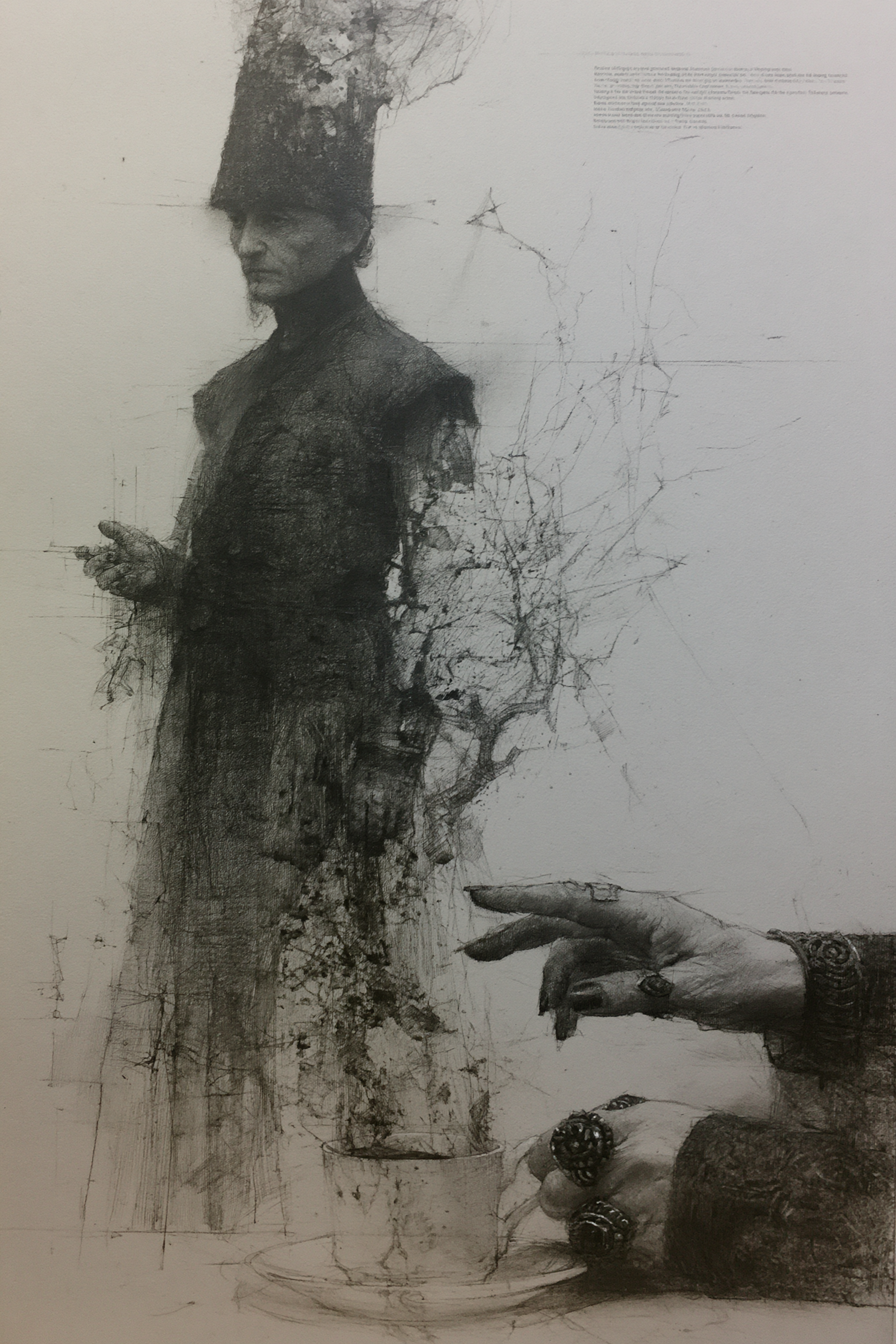
The pine ceiling was stained Benson & Hedges gold.
An Ercol table, its spread wings Pledged to glitter.
Midwinter china, serried on colonial doilies
brought memories of Poona jungles to English snow,
as the mother nursed frothing Turkish coffee.
The boy chewed on a blunt HB pencil,
toes tickling the parquet, back and forth.
Lost in loops and graphite lines,
sure that six boxes could be joined.
His dead father would not have lied.
The old aunt sat, knees wide from thigh fat,
Indian amethyst rings on yellow fingers,
her steel glasses stern on ruddy skin.
She held the mother and patted away tears
in a silver bangle chorus.
For the boy, she wove tales with ash and smoke.
Weft from La Martinière: warp of her Chowringhee hotel.
And of an absent younger brother,
the sisters called T'oros, even into his thirties.
The boy listened, pencil paused, mouth open.
The aunt drank the last black mouthful,
your fortune's in the grounds, she said.
She flipped cup in saucer, turned it left twice
as it bled my future down the porcelain wall.
You'll be rich, she said. The women smiled.
Tell me about your granddad, Auntie.
Her hand remained on the saucer,
but her fingers embraced the upturned cup,
turning it by the rim, two turns right,
as if to unwind ghosts.
It was the Great War, she said.
We had a fine house in Constantinople,
with green tiles and a courtyard fountain.
Your great-grandfather was a scholar
of books, language and our church.
He spoke Russian and Greek,
Turkish and Armenian, and wrote of icons
and of our family saint the martyr.
He translated from gold leaf and incense into ink.
The Catholicos knew his work.
His wife entertained.
Dolmades, coffee, sweet things on small plates,
their house was full of voices.
Men came to argue, women to be seen.
Children ran where they were told not to run.
Then the Ottomans blamed us for their losses.
They said we had betrayed them to the Russians.
It was a lie, boy.
They wanted icons to betray, and books to spy.
But the Turks weren't after reason.
They came in the night, with sticks and boots.
Her gown was torn as they dragged her.
They shouted in Turkish,
and the two boys were crying,
as your great-grandfather held them.
They beat his back because he would not kneel
as he prayed to the martyr.
One arm around two boys, the other held his wife,
and in his hand, foolish man,
he clutched a book.
A book.
As if scholarship were a passport.
As if pages could reason with boots.
As if a man might carry faith in his arms.
But they threw his book into the gutter,
and laughed at his outstretched fingers.
The boy was still.
The mother clasped her hands in prayer.
They watched the old aunt's fingers
circle the cup, circle the cup.
The grounds leaked across the saucer.
They marched them towards Syria, she said.
Mothers carrying children, old men falling.
The soldiers rode, ate bread and laughed.
Some had shoes and some had family,
The road took from them both.
At the border they tried to escape.
Your great-grandmother ran with the boys.
She hid in sewage. In sewage, boy.
She pressed them into the filth,
and heard the men search for them.
Mardiros waited for them. Sitting on the latrine.
Knowing he would be found. Wanting to be found
for the search would end.
He waited.
His wife and children below him in the dark and stink.
They found him, bound his hands
and dragged him into the street.
He knew his wife was listening.
He knew his boys were pressed into shit
and trying not to breathe.
She heard his cries and watched through a crack.
And blocked the ears of her children with filthy hands.
He would not tell. He did not tell.
So you are here and you bear his name.
Hold your head high when you say it, child.
But this, boy.
Forever this.
Remember.
They nailed horseshoes to his feet and made him march.
By Peter Martiros Merrens
Discussion