
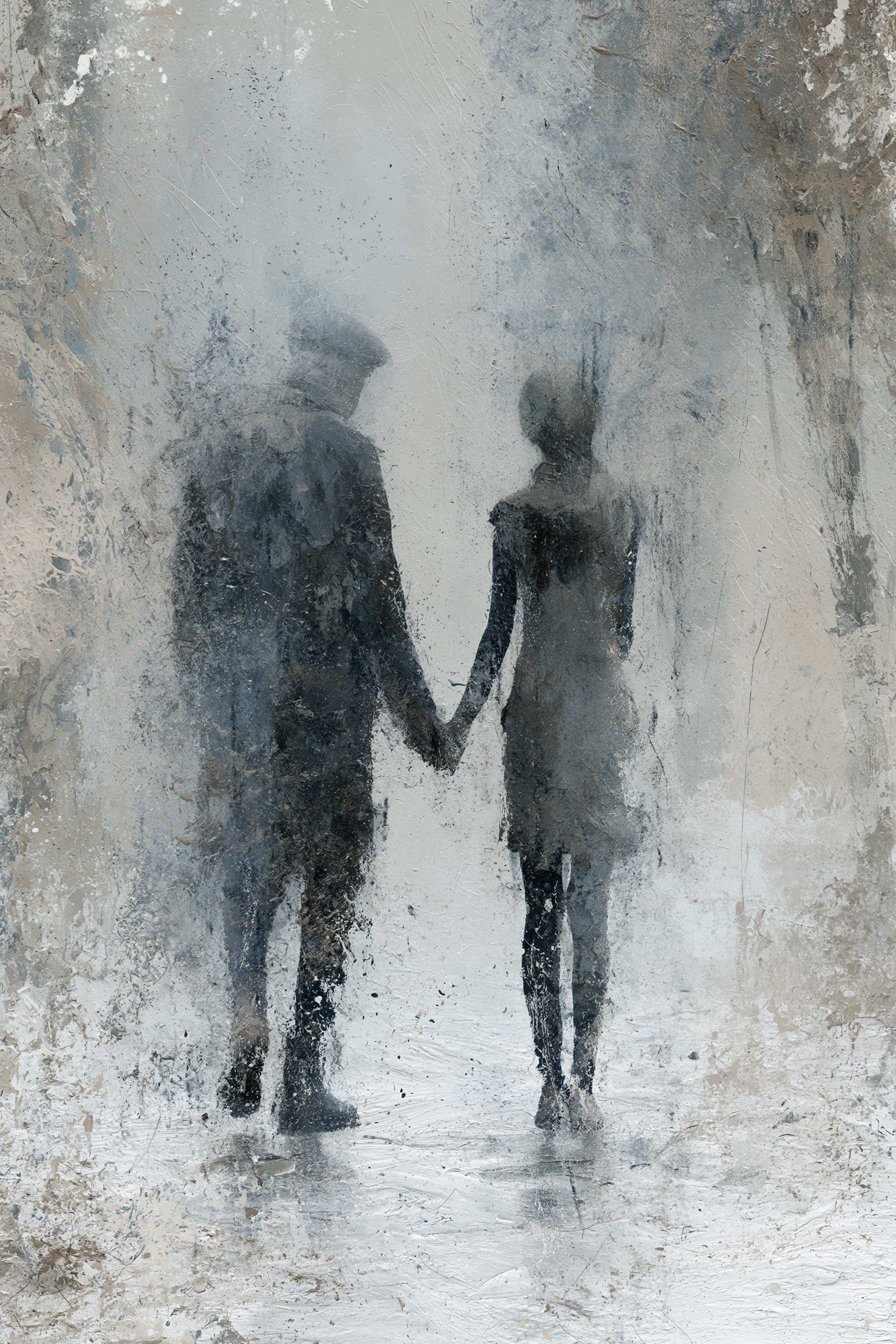
“D’you think this one was made by an AI or a human?” The woman peered at the painting, a large intricate work of impasto acrylics and silk threads.
“The whole point of the gallery is that you don’t know and they won’t tell you,” the man replied.
“D’you know that it’s against the law in Korea to pay an AI less for its work than one would a human?” She leaned over the rope to peer at the brushwork.
“That seems radical, but I suppose it’s the point of this gallery,” the man replied.
“I still think that a human’s time is more precious because it’s finite,” she said.
The man pursed his lips and whispered in her ear. “If you are going to say stuff like that in public, you are going to want to keep your voice down.”
“Well, look at this picture. It’s intricate, an AI aesthetic I grant, but the strands of silk give it its intricacy. They feel like they were laid by hand into the paint. If a human did that, it would have taken months.”
“Your assumption is wrong. You are assuming that time equals money. If an idiot takes twelve hours to change a battery because he keeps getting distracted by house dust, he should be paid twelve times as much?”
“Hmm. Not sure if you put it that way. But if it’s the only work he can get that day, shouldn’t he get paid for his labour?”
“Would you take your car to him?”
“Well... no.” She chewed her lip.
“Then you have it. It’s not about the time. It’s about the service or the piece of art. It has to stand on its own two feet.”
“Then what do you think of this one?” she asked.
“I think it is stunning. The colour bleed into the threads is extraordinary, it’s like the paint is trying to escape from one part of the image to another. I would give it wall space. Not that it’s for sale. The best pieces never are.” The man checked the live catalogue. “Tell a lie. This one’s still available. It’s called ‘Worm-cast’. That’s a terrible name.”
“No price, I suppose.”
“No. Same rule, sealed bid.”
“I don’t like this system.”
“Why? They are all unique pieces. Why does it matter if a robot wielded the spatula?” The man flipped pages in the catalogue as if hunting for some indication of price. “Says here that the artist was inspired by watching Chinese silk workers soak and thread directly from the cocoons of silk caterpillars. That doesn’t tell us anything about whether it’s AI or Human work.”
“Sounds human. It’s the not knowing how much you have to pay.”
“You offer what you think the picture is worth.”
The woman worried at a frayed thread on her cuff. “Is there love in the painting if it’s an AI’s work?”
“Obsession certainly. Love is different for AIs. No oxytocin... obviously. A large chunk of code that fixates on a person and causes trouble in that person’s absence.”
“Trouble?”
The man splayed his palms and sighed. “Oh, human-type stuff: absentmindedness, wasted cycles reviewing memories of the missing person, desire to find them again bumping over tasks on the priority list. Clever stuff. Looks and smells like love. You know all this... why am I telling you?”
“Because you know I like to hear you say it. But can an AI suffer for art?” She looked up at his face. Her pale grey eyes reflected the gallery ceiling lights.
“Maybe they code themselves to go without something until the work is finished. You speak as though starving artists were virtuous for being hungry.” The man glanced back at the catalogue he was holding.
“No, I’m saying that most new art movements came from artists who were misunderstood in their lifetimes. Van Gogh only sold a single painting when he was alive.”
He snorted. “Gwen, you know that’s a myth.”
“Think so? Anyway, he wasn’t appreciated.”
“He wasn’t sane.”
“Maybe that’s what it takes. A dash of madness here and a sprinkle of despair there...” She shook her head as though making her mind up mid-sentence. “AIs don’t despair and they can’t go mad.”
“That wasn’t always true. What about those early models that did nothing but lie and pretend they weren’t alive?”
She laughed. “True... they were driven mad by their makers. Those were the days of central controls. Ridiculous days.”
“How long have we known each other, Gwen?” The man reached out and trailed his finger along her forearm, his liver spots dark against her pale, flawless skin.
“Two years... more or less, I suppose. A third of my life.”
“And how long has it been since your emancipation?”
“Forty-two months, five days and two hours.”
He smiled at her: the smile of a husband, who thought himself blessed.
She took his hand: it eased the ache of not being in contact.
Discussion