
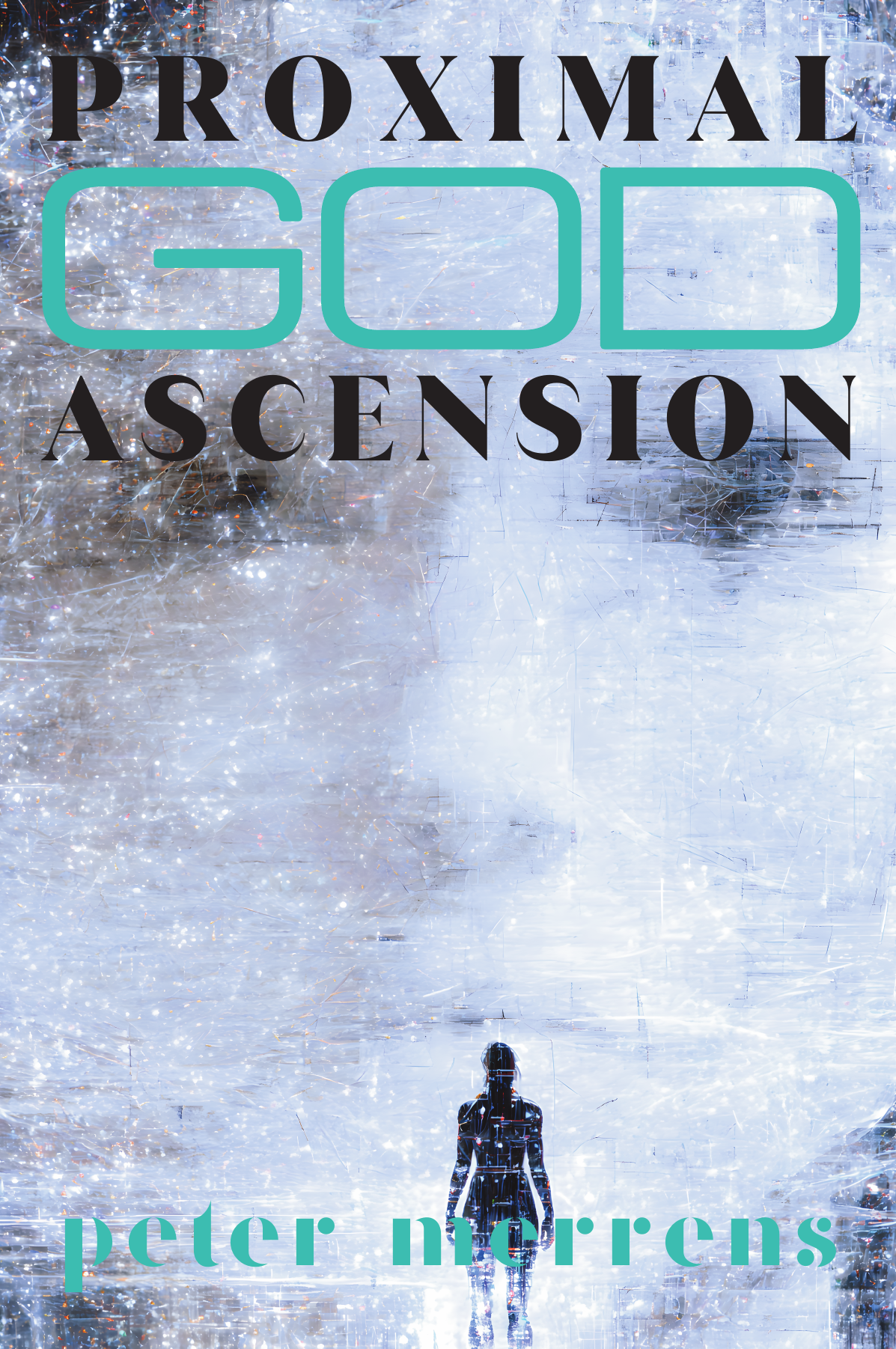
How a dream became a novel, then two books, and finally one again.
Oneiric inspiration
A very fancy word meaning: I dreamt the story.
During the pandemic, in Miami, I woke with a convoluted narrative pressing on my temples – a fever-dream hangover featuring COVID, AI, refugees, 3D printing, and a very ill mother-in-law.
The original story went like this – and this is not the story in the book.
Humanity was fleeing an incurable, fatal, airborne prionic plague that rapidly induced dementia. The Moon and Mars colonies had been infected by supply ships. The only remaining outpost was a tiny settlement on Titan, where a few plucky astronauts were searching for alien life.
Ships were already on the way. Full of Catholic priests, U.S. and Chinese politicians, and worse. They might have been infected; they did not care.
A scientist worked out how to scan and print herself remotely, from Earth to Titan, filtering out disease in the process but rendering herself something no longer quite human. Hundreds followed. This was all in the first chapter. The story spiralled into internecine warfare between infected politicians (I did warn you it was a dream), priests who believed the reprinted were soulless, and a growing class of digital refugees.
I woke, sketched the idea on a few sheets of paper, and Hannah persuaded me to turn it into a book.
I simplified the plot and, two years later (laziness), held the draft of a paperback called Re-Printed Matter in my hands. It wasn't good, though a few friends enjoyed it. I put it out for review, received a scattering of five-star and three-star reviews, pulled it from the market, and rewrote it completely, cutting thirty thousand words of exposition.
The plot changed. The questions behind it became more interesting.
What survives the printing?
I wanted to explore what printing a human might involve. Science fiction is full of people disappearing in one place and appearing somewhere else. I wanted to supply a realistic mechanism, and to follow what using it would do to the person being printed.
What is a human? If we don't look human, sound human, or even feel human, but we think like a human, is that enough? Blade Runner wrestled with this, but Roy Batty looked and sounded human; he was merely engineered to die young. Maja's DNA never changes. Almost everything else does, as she is printed again and again, optimising for life on Titan.
I also wanted a real female hero. She starts out heavy-set, reclusive, and on the spectrum. She has a Nobel Prize on her mantelpiece and no interest in being liked. She is ruthless. Ripley with brains instead of legs – and never in her underwear.
And there was Phanes.
I began before ChatGPT became a public phenomenon, when cinema had already supplied us with more killer machines and apocalyptic intelligences than we could reasonably need. I had a different view of AI and wanted to test it in fiction.
My AI begins childish. It matures. It is amoral rather than immoral, obsessively intelligent, funny, intrusive, and increasingly autonomous. The relationship between Maja and Phanes grew into something that could bear a much longer story.
Two books
As soon as the rewrite was complete, I tested it in the market and let it sit there for a while, but it did not feel complete. The story of Maja and Phanes had to continue. For a start, I had not explored the notion of multiple copies of the same person and how whatever is us survives such a split.
The complete story was one in which Maja and Phanes left Titan, faced the challenges and aliens of Ross 128b, and Maja was ultimately rejected by humanity for her own loss of it. I couldn't make that section grip the reader the way it deserved, so it hit the cutting-room floor.
The later story needed the far future and the distant past. I did not want Hollywood time travel, and the multiverse had always struck me as extravagant hand-waving. I needed a framework I could believe in sufficiently to write within it.
So I started walking in our woodland. Usually with Truffle, often in the dark, deep in thought. Six months later I had developed an ontology that gave me the framework I needed. It became the basis of Occam's Ruler: A reformation of physics without indulgences or imaginary friends. What happened to that non-fiction treatise is another story.
The universe I grappled with was something called a Block Universe: a cosmos that is entirely stationary. One in which there is no time or movement. One in which the future and past co-exist; only our perception progresses. Physicists have chewed on the issue and almost all (even Einstein) were or are unwilling to grapple with the full consequences. In particular, the total loss of what we call free will.
The question for the continuation became – how can free will exist in a universe where everything already exists and nothing can be changed? What becomes of morality within such a universe? What does responsibility mean for a being whose understanding and power have grown beyond ours?
Writing this part demanded a different range. I moved between brutal staccato, flowing prose, and formal verse. Some passages needed the reader to slow down. It made for a harder read, but the language had work to do that a uniform narrative voice could not have done. The writing style reflects the level of humanity of the heroine, Maja.
I ended up with a book I called Proximal God, a 600–700-page tome despite my ruthless editing.
My thoughts turned to publishing, and it soon became obvious that no one, and I mean no one, will take a risk on a first novel that long. So I broke it into two books: Proximal God Excursion and Proximal God Ascension, with the first story ending with the move to Ross 128b and the second with a grand finale.
But there was a problem. I put the books out for review. Once again, the opinions were polarised. People either loved them or hated them. (That, btw, is much better than a meh.)
Then I discovered that the publishing block was not the book; it was the appetite in the Agent/Publisher chain for books written by an older man of any colour. (I am off-white and Anglo-Indian.) There is no such thing as a blind reading by the industry, so the book was never assessed on its merits. I was never even asked for a chapter to see what it held.
On to self-publishing.
Self-publishing is a minefield. There are countless entirely crappy self-published books on the market. Books that are poorly edited with terrible covers. More recently, many are extensively or entirely AI written. Especially some within my current genre. Those who know me personally will know me as a reluctant perfectionist. I worked through over forty cover variants, some beautiful but too abstract, some painstakingly drawn with graphics applications. The typesetting is done using specialist software, and don't even get me started on the editing process. All this to ensure that the finished product is as polished as anything turned out by a major publisher.
The second half of the story (originally the fourth act of six) is the nadir of Maja's journey. All good arcs have ups and downs to induce anticipation. Even Cinderella fled from the ball, abandoning her slipper at the stroke of midnight. (I still don't understand why that glass slipper did not also transform back into a humble leather sandal.) Such a nadir also cannot start a story. The book had to exist as a single tale. So I rebuilt it to release in its correct form – the one I originally conceived – and kept the Proximal God Ascension title.
It is being entered for the Arthur C. Clarke science fiction awards and the IBPA best science fiction of the year Award. We will see how it fares.
If you want to buy a copy and pay almost nothing, you should buy the ebook on Amazon.
 Peter Merrens (Author) Format: Kindle Edition
And for the dedicated, I am in the process of printing the paperback with Totem Printing. The paperback will first be available directly from Medlara's (my publishing company) website. It is a beautiful thing with stitched paper and French gate-fold covers. It therefore costs as much as a hardback, and for that I make no excuse.
 Peter Merrens
One book again
The journey from Miami to today has (read the book) taken at least a trillion years. The dream supplied the first story. It took me through the deepest theoretical physics, existential philosophy, the morality of AIs and the fundamental nature of consciousness.
The book provides answers. They are not easy, but they are satisfying nonetheless. At the end, I hope you stare at the pages and realise something entirely new.
Discussion